
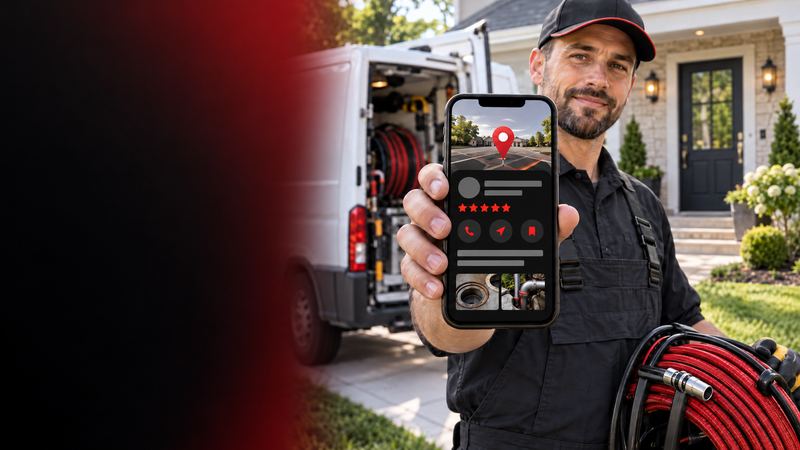
For sewer, drain, and trenchless companies, Google Business Profile can be one of the most important sources of local visibility.
A strong profile can help potential customers find your business when they search for services such as:
- Drain cleaning
- Sewer repair
- Hydro jetting
- Sewer replacement
- Pipe lining
- Trenchless repair
- Camera inspections
But simply having a profile is not enough.
The information needs to be accurate, complete, consistent, and supported by the rest of your local SEO strategy.
Why Google Business Profile Matters for Sewer & Drain Companies
Many local searches show Google Maps results prominently.
A potential customer may see:
- Business name
- Rating
- Number of reviews
- Photos
- Hours
- Phone number
- Website
- Service information
before they ever visit your website.
That makes Google Business Profile more than a simple business listing.
It is one of the main places where customers may decide whether to contact you.
Google Maps Visibility Depends on More Than One Setting
There is no single button that makes a company rank across an entire market.
Local visibility is influenced by multiple factors, including:
- Relevance
- Proximity
- Prominence
- Business category
- Website relevance
- Reviews
- Authority
- Searcher location
- Competition
That means Google Business Profile optimization should be part of a broader local SEO strategy.
1. Use Your Real Business Name
Your Google Business Profile name should reflect the actual name of the business.
Avoid adding unnecessary keywords such as:
- Sewer Repair
- Drain Cleaning
- Best Plumber
- Hydro Jetting
unless they are genuinely part of the real-world business name.
Keyword stuffing a business name may create unnecessary compliance risk.
Your name should be consistent across:
- Website
- Google Business Profile
- Business documents
- Signage where applicable
- Important business listings
2. Choose the Right Primary Category
The primary category helps Google understand what type of business you operate.
This can be one of the most important profile settings.
Choose the category that most accurately represents the core business.
A company primarily focused on drain services may need a different primary category than a general plumbing company.
A trenchless specialist may also have a different category strategy.
Do not choose categories only because competitors use them.
They should accurately represent the business.
3. Add Relevant Secondary Categories
Secondary categories can help describe additional parts of the business.
Only add categories that genuinely apply.
Too many unrelated categories can make the profile less focused.
Review the company’s actual services first, then select relevant supporting categories.
4. Complete the Services Section
The Services section gives you another opportunity to clearly explain what the business does.
Depending on your actual offering, services may include:
- Drain cleaning
- Sewer cleaning
- Hydro jetting
- Sewer camera inspection
- Sewer line repair
- Sewer replacement
- Pipe lining
- Pipe bursting
- Trenchless sewer repair
Keep these services aligned with the website.
If pipe lining is a major service on the profile, the website should also have strong pipe lining content.
5. Write a Clear Business Description
Your business description should explain:
- What the company does
- Who it serves
- Core services
- Service territory
- Relevant differentiators
Avoid stuffing the description with repeated keywords.
A natural description is better than something like:
We are the best sewer repair sewer repair company offering sewer repair and drain cleaning...
Instead, write for real customers.
6. Make Sure the Phone Number Is Correct
A wrong phone number can cost real leads.
Check:
- Primary phone number
- Secondary phone number if used
- Website phone number
- Call tracking configuration
- Other important listings
If call tracking is used, it should be implemented carefully so business information remains consistent.
7. Use the Correct Website URL
The website link should usually direct customers to the most appropriate primary page.
You may also want tracking parameters in place so you can measure traffic and leads coming from Google Business Profile.
This can help separate:
- Google Maps traffic
- Organic website traffic
- Paid traffic
Better attribution makes performance easier to understand.
8. Configure Service Areas Accurately
Many sewer and drain businesses operate as service-area businesses.
Service areas should accurately represent where you work.
Adding dozens of cities does not automatically make the business rank in every city.
Local visibility still depends on factors such as:
- Searcher location
- Competition
- Business location
- Website authority
- Relevance
- Reviews
Treat service areas as business information, not as a ranking hack.
9. Keep Business Hours Accurate
Hours matter most when a customer needs service urgently.
Make sure:
- Regular hours are correct
- Holiday hours are updated
- Emergency availability is represented accurately
- Staff can actually answer during listed hours
Do not advertise 24/7 service unless the business genuinely operates that way.
10. Add High-Quality Real Photos
Real photos can help demonstrate that the business is active and legitimate.
Useful images include:
- Service trucks
- Technicians
- Equipment
- Drain cleaning work
- Hydro jetting
- Sewer camera inspections
- Excavation
- Pipe lining
- Pipe bursting
- Completed repairs
Avoid relying entirely on stock images.
Real job-site content is much more useful for building trust.
11. Add Photos Consistently
Do not treat photos as a one-time setup task.
Continue adding new material as the business completes work.
Possible ongoing photo categories include:
- New equipment
- Team
- Completed projects
- Before-and-after images
- Job-site photos
- Commercial projects
- Specialized trenchless work
This keeps the profile reflective of the actual business.
12. Use Google Posts Strategically
Google Posts can help keep the profile active and highlight important services.
Possible topics include:
- Drain cleaning
- Hydro jetting
- Pipe lining
- Trenchless repair
- Seasonal sewer problems
- Recent projects
- Maintenance tips
A useful post should have:
- Clear topic
- Relevant image
- Helpful information
- Appropriate CTA
Avoid publishing the same generic promotion repeatedly.
13. Build a Consistent Review Generation Process
Reviews should not depend entirely on customers remembering to leave one.
Create a repeatable process.
For example:
- Job completed
- Customer satisfaction confirmed
- Review request sent
- Optional reminder
This can be managed manually or supported by CRM automation.
The key is consistency.
14. Do Not Script Customer Reviews
Customers should describe their own experience naturally.
Avoid asking them to copy specific wording or include exact keywords.
Instead, make it easy for them to leave genuine feedback.
Authentic reviews often naturally mention:
- Type of service
- Problem
- Team member
- Communication
- Location
- Outcome
That provides stronger trust than obviously scripted feedback.
15. Respond to Positive Reviews
Positive review responses should be brief, professional, and human.
A good response may:
- Thank the customer
- Mention the service naturally
- Acknowledge the team
- Reinforce appreciation
Avoid copying the exact same response onto every review.
16. Handle Negative Reviews Professionally
Negative reviews should not trigger emotional responses.
A strong response may:
- Acknowledge the concern
- Stay factual
- Avoid arguing publicly
- Offer a direct path to resolve the issue
Remember that the response is not only for the reviewer.
Future customers will read it too.
17. Monitor Reviews for Policy Violations
Some reviews may violate platform rules.
Examples could include:
- Spam
- Fake engagement
- Irrelevant content
- Conflicts of interest
- Harassment
If a review appears to violate policy, report it through the appropriate process.
Do not assume every negative review qualifies for removal.
18. Add Relevant Q&A Content
Potential customers often ask similar questions.
Useful topics may include:
- Do you offer emergency sewer repair?
- Do you provide trenchless sewer replacement?
- Do you offer hydro jetting?
- Can you inspect sewer lines with a camera?
- Do you work with commercial properties?
Any public information should remain accurate and consistent with the website.
19. Keep the Website and GBP Aligned
Your Google Business Profile should not exist separately from the website strategy.
If the profile emphasizes:
- Sewer repair
- Pipe lining
- Drain cleaning
- Hydro jetting
then those services should be clearly supported by the website.
Google and potential customers should see a consistent business story across both assets.
20. Build Strong Service Pages
A strong Google Business Profile is more useful when it links to a strong website.
Important service pages may include:
- Sewer repair
- Drain cleaning
- Hydro jetting
- Camera inspection
- Pipe lining
- Pipe bursting
- Trenchless repair
These pages help reinforce relevance and improve conversion after a visitor leaves Google Maps.
21. Strengthen Local Landing Pages
If the company serves multiple important areas, local pages can support organic visibility.
A location page should contain more than a city name.
Useful elements may include:
- Services offered
- Local project examples
- Reviews
- Nearby service coverage
- FAQs
- Real photos
- Clear CTA
Avoid mass-producing thin city pages.
22. Build Local Citations
Business information should be accurate across relevant listings.
That may include:
- Apple Maps
- Bing
- Yelp
- Local directories
- Industry directories
- Chambers of commerce
Review:
- Name
- Address
- Phone
- Website
- Hours
Consistency helps create a stronger local business footprint.
23. Earn Local and Industry Backlinks
Local and industry authority can support both website and local visibility.
Potential opportunities include:
- Local sponsorships
- Trade associations
- Industry publications
- Local news
- Supplier relationships
- Community organizations
- Business associations
Avoid low-quality bulk link schemes.
24. Use Real Project Content
Local service businesses have a major advantage:
They constantly create original content through real jobs.
A sewer repair project may become:
- Website case study
- Google Business Profile photo
- Google Post
- Social media post
- Before-and-after example
- Supporting service content
One real job can support multiple marketing channels.
25. Monitor Local Rankings Geographically
Local rankings can change significantly depending on searcher location.
A business may rank strongly near its location but poorly several miles away.
Local grid tracking can help show:
- Areas of strong visibility
- Weak areas
- Competitor strength
- Changes over time
This gives you a better local picture than checking from one device.
26. Track Google Business Profile Traffic
Use tracking wherever possible to understand what GBP generates.
Track:
- Website clicks
- Phone calls
- Forms
- Landing-page sessions
- Conversion actions
The objective is not simply to increase profile activity.
It is to understand whether that activity produces meaningful leads.
27. Optimize for Lead Conversion
Visibility only matters if customers actually contact you.
When a customer lands on the website from Google Maps, make sure they immediately see:
- Relevant service
- Phone number
- CTA
- Reviews
- Real photos
- Service area
- Trust information
A strong profile connected to a weak website can still lose leads.
Common Google Business Profile Mistakes
Keyword Stuffing the Business Name
Adding services or cities that are not genuinely part of the business name can create compliance problems.
Using an Ineligible Address
Do not create a fake office or location purely to improve rankings.
Business locations should meet Google's eligibility requirements.
Creating Duplicate Profiles
Multiple profiles for the same business can create confusion and potential problems.
Constantly Changing Important Information
Repeated changes to name, category, address, or other major fields can create unnecessary risk.
Make changes because they are accurate and necessary.
Ignoring Reviews
A profile with weak or stagnant reviews may struggle to convert even if it gets visibility.
Using Only Stock Photos
Stock imagery gives potential customers little proof that you perform the work.
Treating Service Areas Like Keywords
Adding every city in a state does not create rankings in every city.
Ignoring the Website
Your profile and website should reinforce each other.
Google Business Profile for Multi-Location Companies
Companies with multiple legitimate locations need a more structured approach.
Each location should have:
- Accurate address
- Accurate phone
- Correct hours
- Appropriate categories
- Unique location page
- Reviews
- Photos
- Tracking
Avoid unnecessarily mixing data between locations.
Lead routing should also be clear so customers reach the correct team.
Google Business Profile for Service-Area Businesses
Many sewer and drain contractors visit customers rather than serving them at a storefront.
For service-area businesses:
- Configure the profile accurately
- Hide the address when required by Google's rules
- Define legitimate service areas
- Keep business information consistent
- Support the profile with strong service and location content
Do not use virtual offices or fake locations simply to gain geographic reach.
How GBP Fits Into a Complete Local SEO Strategy
Google Business Profile works best when supported by:
GBP Optimization
Strong Website
Service Pages
Reviews
Local Content
Backlinks
Citations
Conversion Tracking
Local SEO is the combination of these signals, not one profile setting.